
THEBUSINESSBYTES
BUREAU
NEW
DELHI, OCTOBER 8, 2026
India aims to secure
at least 10 per cent of global 6G patents and standards, while developing
indigenous alternatives to critical imported network technologies, Union
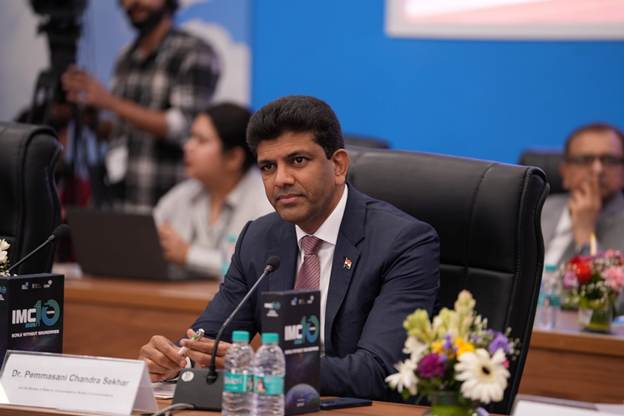
Minister of State for Communications Dr Chandra Sekhar Pemmasani said on
Thursday.
Addressing telecom industry
stakeholders at the “Shaping the Intelligent Infrastructure for 6G: A
Technology Leadership Dialogue, CTO Round Table” on the sidelines of IMC 2026
in Delhi, Pemmasani called for a concerted push to make India a technology
leader in next-generation communications.
The minister said
India should identify 10-20 critical network technologies that are currently
imported and work towards developing domestic alternatives, particularly in
components, chipsets, radios, routers and optical systems.
“India should not merely be a large market for
telecom technologies, but must emerge as a significant contributor to the
global technology ecosystem,” he said, underlining the need for greater
industry participation in 6G standards, standard-essential patents and
university-led research.
Pemmasani said major
telecom operators should set measurable annual and quarterly targets for
contributions to global standards and patents, while strengthening
collaboration with academic institutions and technology companies.
Highlighting the
progress made by India’s telecom sector, he said the country has connected more
than a billion people, while every district has been covered by 5G through
nearly 5.6 lakh base transceiver stations. Villages are also being connected
through 4G, alongside the development of an indigenous 4G stack.
Acknowledging the
contribution of industry stakeholders, the minister said the government has
also moved to strengthen the regulatory framework governing the sector. Most of
the rules under the Telecommunications Act, 2023 have now been notified, with
the objective of creating a simpler, technology-neutral framework suited to a
rapidly evolving technology landscape.
He said BharatNet and
4G saturation projects are aimed at extending high-speed fibre connectivity and
mobile services to every village and, ultimately, every household.
The minister also
highlighted the government's growing focus on telecom research and development,
saying nearly 136 projects worth around Rs 500 crore have been funded under the
Telecom Technology Development Fund.
These projects span
5G and 6G technologies, quantum communications, non-terrestrial networks,
advanced optical systems, indigenous telecom core networks and telecom
security. He also pointed to 5G testbeds established at academic institutions,
enabling students, researchers and startups to experiment with emerging
technologies and develop new solutions.
On quantum
communications, Pemmasani called for the technology to move beyond laboratories
and into real-world telecom applications. He urged C-DOT to undertake operator
trials, including quantum-safe encryption on critical links and Quantum Key
Distribution wherever economically justified.
The minister also
called for a transition from AI-assisted networks to AI-native networks, with
artificial intelligence becoming integral to the design and operation of future
telecom infrastructure.
At the same time, he
stressed that the rapid adoption of emerging technologies must be accompanied
by stronger safeguards covering national security, equipment security, supply
chains, fraud prevention and protection of critical telecom infrastructure.
Pemmasani urged closer cooperation among the government, telecom operators, equipment manufacturers and technology companies to accelerate innovation and address policy bottlenecks. He invited industry stakeholders to submit their priorities and identify areas where regulations and policies could be simplified in line with technological advances.
“The last decade was Digital India. Our goal is to make the next decade an Intelligent India,” Pemmasani said, setting out the government's broader vision of leveraging telecom and emerging technologies to drive India's next phase of digital and technological growth.