THEBUSINESSBYTES
BUREAU
NEW
DELHI, OCTOBER 8, 2026
India's maritime
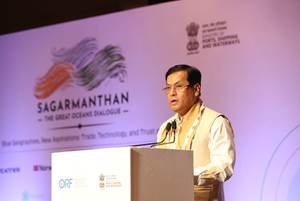
future will be written by its young people, Union Minister for Ports, Shipping
and Waterways Sarbananda Sonowal said on Thursday, as India expanded maritime
cooperation with Saudi Arabia, Belgium, Bhutan and other countries while
pushing investments, green shipping, port connectivity and skill development at
the Sagarmanthan: The Great Oceans Dialogue 2026.
On the second day of
the global maritime dialogue, Sonowal held bilateral meetings with Saudi
Arabia, Belgium and Bhutan, carrying forward India's maritime partnerships
across the Gulf, Europe and the neighbourhood, while placing youth and women at
the centre of the country's maritime growth story.
In talks with a
delegation from the Saudi Ports Authority (Mawani), Sonowal discussed Saudi
participation in major Indian port projects, including Vadhavan and Galathea
Bay. The discussions also covered cooperation in shipbuilding, seafarer
training and resilient supply chains, with Saudi Arabia expressing interest in
investing in India's port projects as well as the Maritime Development Fund
(MDF).
With Flemish Minister
for Mobility, Public Works, Ports and Sport Annick De Ridder, Sonowal proposed
exploring a green shipping corridor linking Indian ports with Antwerp-Bruges,
while the two sides discussed green fuels, smart port technologies and
dredging. VOC Port has also signed an agreement with the Port of Antwerp to
build capacity in green shipping and green fuel.
During his meeting
with Bhutan's Minister of Infrastructure and Transport Lyonpo Chandra Bahadur
Gurung, Sonowal highlighted National Waterway-2 and the Jogighopa terminal as
potential gateways for Bhutan to access global trade. The two sides discussed
the potential of the Manas and Sankosh rivers, their connectivity with national
waterways and ways to improve cargo movement. They also discussed maritime
training opportunities for Bhutanese youth at the Centre of Excellence in
Dibrugarh, which is under development.
"Our talks with
Saudi Arabia, Belgium and Bhutan show how India's maritime partnerships are
growing across regions," Sonowal said, adding that India is exploring
investments in ports, shipbuilding and resilient supply chains with Saudi Arabia,
while working with Belgium on a green shipping corridor and smarter ports and
with Bhutan on opening the Brahmaputra as a gateway to global markets.
At sessions titled
'The Future is Blue: The Next Maritime Generation' and 'Ocean Changemakers:
Women, Youth and India's Maritime Journey', Sonowal heard directly from young
Indians and women about their aspirations for the maritime sector. An all-women
tri-service sailing expedition also participated in the programme and inspired
women cadets.
India's seafarer
workforce has expanded sharply from 1.27 lakh to 3.23 lakh over the past 12
years, taking the country from the fifth position in 2015 to the world's
second-largest supplier of seafarers, with Indian professionals accounting for
more than 12 per cent of the global workforce.
The number of active
women seafarers has also increased from 1,599 in 2021 to 7,033 in 2025,
supported by the Sagar Mein Samman initiative. India has set a target of
increasing the participation of women in the maritime workforce through Mission
20% by 2030.
To strengthen the
pipeline of skilled maritime workers, shipyard-ITI partnerships now provide 150
hours of on-the-job training, while a structured six-month onboard programme
for GP Rating and Maritime Catering trainees is aimed at bridging the gap
between pre-sea training and life at sea.
"India's
maritime future will be written by the youth," Sonowal said. "Today,
our seafarers are trusted and respected on every ocean, and more women than
ever are choosing careers at sea. We are building the skills, institutions and
opportunities so that every young Indian who dreams of the sea can help lead
the world's maritime economy."
The second day of
Sagarmanthan also featured discussions on securing global trade chokepoints,
strengthening the role of the Global South in maritime affairs, artificial
intelligence in maritime operations, green ports, equity in ocean futures,
BRICS+ connectivity and green shipbuilding.
Separately, Union
Minister of State for Ports, Shipping and Waterways Shantanu Thakur held
bilateral meetings with Greece, Lithuania, Mozambique and Myanmar, seeking to
deepen India's maritime cooperation across Europe, Africa and the Bay of Bengal
region.
In his meeting with
Greece's Deputy Minister of Maritime Affairs and Insular Policy Stefanos
Gkikas, Thakur discussed strengthening India-Greece maritime cooperation. With
Lithuania's Minister of Transport and Communications Juras Taminskas, he
proposed a work plan for the memorandum of understanding between the Jawaharlal
Nehru Port Authority and the Port of Klaipėda, besides discussing direct
shipping links and green port cooperation.
With Mozambique's
Minister of Transport and Logistics João Jorge Matlombe, Thakur offered India's
expertise in ports, shipbuilding, ship repair and seafarer training. His
discussions with Myanmar's Deputy Minister of Transport U Tun Lu focused on the
next phase of Sittwe Port, cross-border inland water trade and maritime safety
in the Bay of Bengal.
"From the Baltic
to the Bay of Bengal, India is ready to share its strengths in ports,
shipbuilding and seafarer skills so that we can grow together with our
partners," Thakur said, underlining India's focus on green shipping, connectivity
and capacity building.
Addressing a press
conference at Sagarmanthan, Sonowal said India had moved from "maritime
potential to maritime performance" under Prime Minister Narendra Modi.
Minister of State Shantanu Thakur and Shipping Secretary Vijay Kumar also
accompanied him.
Over the past 12
years, India's port capacity has increased from 1,561 million tonnes per annum
(MTPA) to 2,817 MTPA, while cargo handled has risen from 1,052 million tonnes
to 1,668 million tonnes. Inland waterways cargo has surged from 29 million
tonnes to 218 million tonnes, while median container vessel turnaround time has
fallen from 35 hours to 23 hours.
Sonowal also
highlighted the growing international footprint of Sagarmanthan, saying
participation had increased from more than 1,700 delegates representing 61
countries in 2024 to participants from more than 70 countries this year,
including 10 visiting ministers. The dialogue has also produced more than 100
publications aimed at strengthening India's contribution to the global maritime
order.
India is
simultaneously stepping up efforts to develop green hydrogen, ammonia and
methanol capacity, with the objective of transforming Indian ports into
green-fuel bunkering hubs in line with the country's Net Zero 2070 commitment.
Calling for a shift from dialogue to concrete action, Sonowal said India was ready to work with international partners on joint research, investment and technology partnerships.
"India is ready to work with the world for safer seas, greener shipping and shared prosperity," he said.