THEBUSINESSBYTES
BUREAU
NEW
DELHI, OCTOBER 8, 2026
India has adopted an
outward-looking approach of building bridges with the world at a time when
several countries were putting up walls, Commerce and Industry Minister Piyush
Goyal said on Thursday, expressing confidence that the country will achieve its
ambitious USD 1 trillion export target this fiscal despite a challenging global
trade environment.
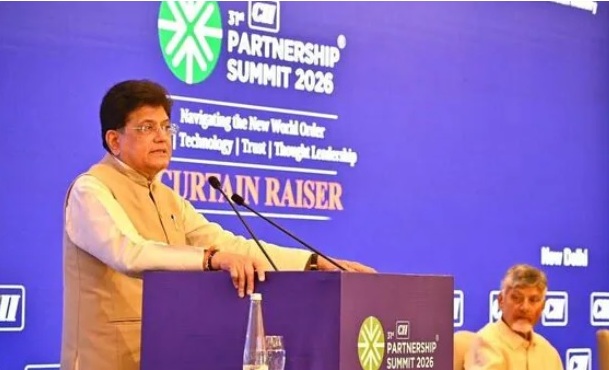
Addressing the
curtain raiser of the 31st CII Partnership Summit here, Goyal said India
clocked USD 863 billion in exports last year and is targeting nearly 16 per
cent growth in exports this year, against an expected 2.5-3 per cent expansion
in global trade.
"India began
building bridges when the world was building walls," Goyal said, underlining
the country's growing engagement with global markets through trade, technology,
talent and investment.
The minister said the
USD 1 trillion export target is not merely a government target but a collective
national ambition backed by India's 63 million MSMEs, large and small
industries, global capability centres and around 2.5 lakh startups.
Goyal also expressed
confidence that India would sustain growth of more than 7 per cent and retain
its position as the fastest-growing large economy, noting that the Reserve Bank
of India has once again raised its growth projection for the current year.
The CII Partnership
Summit, which will be held in Visakhapatnam on November 12-13, will provide an
opportunity for countries and businesses to view India's growth story through
the prism of growth, opportunity and partnership, he said, urging countries to
send strong delegations to the event.
Goyal called upon CII
to establish FTA utilisation desks across its state councils to help MSMEs make
effective use of free trade agreements, understand rules of origin and new
market access opportunities, participate in international delegations and
exhibitions, and showcase their products and technologies to global buyers.
Defending India's
free trade agreements, the minister said the pacts are structured to protect
sensitive sectors, particularly agriculture, fisheries and MSMEs, while
creating new opportunities for exports of farm and marine products, engineering
goods, high-precision items and electronics.
The agreements, he
said, also provide an opportunity for overseas companies to invest in India and
participate in the growth of the world's largest market.
Goyal said India has
moved from an earlier defensive approach towards globalisation to one marked by
confidence, competitiveness and greater willingness to engage with developed
economies.
"Today, India
engages with the world with the self-confidence of a nation on the move,"
he said, adding that the country is bringing technology, talent,
competitiveness and greater market access for its goods and services to the
global table.
The minister pegged
India's economy at around USD 4 trillion and said it has the potential to
expand to USD 30 trillion by 2047, driven by its youthful and aspirational
population and the growing demand for a better quality of life.
He said India is also
embracing emerging technologies rather than viewing them primarily as a threat
to employment. New-age technologies, he said, would create opportunities for
India's young workforce in areas such as cybersecurity and applications built
around emerging technologies while improving productivity and global
competitiveness.
Goyal said technology
would be leveraged to take India's talent and skills to global markets, raise
efficiency and productivity and create newer avenues for jobs, businesses and
entrepreneurship.
Trust, he said, has
emerged as a defining feature of India's engagement with the global economy.
During the COVID-19 pandemic, India honoured its international commitments
relating to merchandise and services exports even amid stringent lockdowns,
while export-oriented units continued to serve global customers by adhering to
prescribed safety protocols.
India's commitment to
service-level agreements with global companies was also maintained during the
crisis, he said, adding that global leaders at the 2022 G20 Summit in Rome had
described India as a "trusted partner of the globe".
Goyal also
highlighted recent credit rating upgrades received by India, saying these
reflected growing confidence in the country's economic fundamentals.
He said Indian
industry is focusing on cutting-edge technology, carbon mitigation and
sustainability, while labour reforms are helping create an environment in which
businesses can grow alongside better wages, social security and amenities for
workers.
The government, he
said, continues to work on ease of doing business, good governance and sustained
dialogue with industry to meet both domestic aspirations and evolving global
standards.
Goyal also
highlighted Prime Minister Narendra Modi's completion of 25 years of
uninterrupted public service, beginning with his tenure as Gujarat chief
minister on October 7, 2001, and continuing as prime minister since May 26,
2014.
Describing it as 25
years of "seva", Goyal said Modi has consistently worked towards
making India a developed and powerful nation and fulfilling the aspirations of
its 1.4 billion people by 2047.
Recalling a verse
from the Bhagavad Gita, he said the standards set by a great leader are
followed by others, and described Modi's leadership over the past 25 years as
an example of leading from the front.
Goyal cited
initiatives including the Jyotigram Yojana, the Jan Dhan-Aadhaar-Mobile (JAM)
trinity and Digital India as examples of technology-led governance and
last-mile delivery.
He also referred to
the introduction of the Goods and Services Tax and the integration of regional
power grids into a single national grid as examples of reforms that chose
structural transformation over the easier path.
Despite the
disruptions caused by the COVID-19 pandemic and ongoing geopolitical conflicts,
India has continued to remain the world's fastest-growing large economy, he
said.
The minister said the
five T's of Technology, Trust, Trade, Talent and Tradition, which he
highlighted at the 2025 Partnership Summit, remain central to India's growth
story.
"Trade,
technology, trust and thought leadership are becoming defining features and
core elements of India's growth story," he said.
Goyal also praised
Andhra Pradesh Chief Minister N Chandrababu Naidu for promoting
technology-driven development and governance, describing the state as the
country's "sunrise state".
He said the Centre
and Andhra Pradesh government working together represented "Team India at
its best", with the Centre opening global markets through FTAs and the
state converting those opportunities into factories, data centres and jobs.
Google's first AI hub
is coming up in Visakhapatnam, while Amaravati is emerging as a quantum valley,
Goyal said, highlighting the state's growing focus on artificial intelligence,
quantum computing and technology-led investment.
He said Andhra Pradesh's emphasis on ease of doing business, coupled with its pool of talent in science, technology, engineering and mathematics, positions the state strongly to benefit from the next phase of India's technology-led growth.
"India today is aspirational, Indian business is confident and the country is commanding global respect," Goyal said, expressing confidence that the 31st CII Partnership Summit would mark another milestone in India's growth journey towards becoming a USD 30 trillion developed economy by 2047.