
THEBUSINESSBYTES BUREAU
NEW DELHI, AUGUST 13, 2026
India’s infrastructure story is no longer just about building
more roads, rail lines and airports—it is increasingly about creating a
seamlessly connected economic backbone. A sharp rise in public capital
expenditure over the past 12 years has fuelled a broad-based expansion spanning
transport, logistics, urban mobility, housing and basic services, while
integrated planning is emerging as a key driver of the next phase of growth.
Public capital expenditure has surged from around Rs 2 lakh
crore in 2014-15 to Rs 12.2 lakh crore in 2026-27, underlining the government’s
sustained push to expand infrastructure capacity.
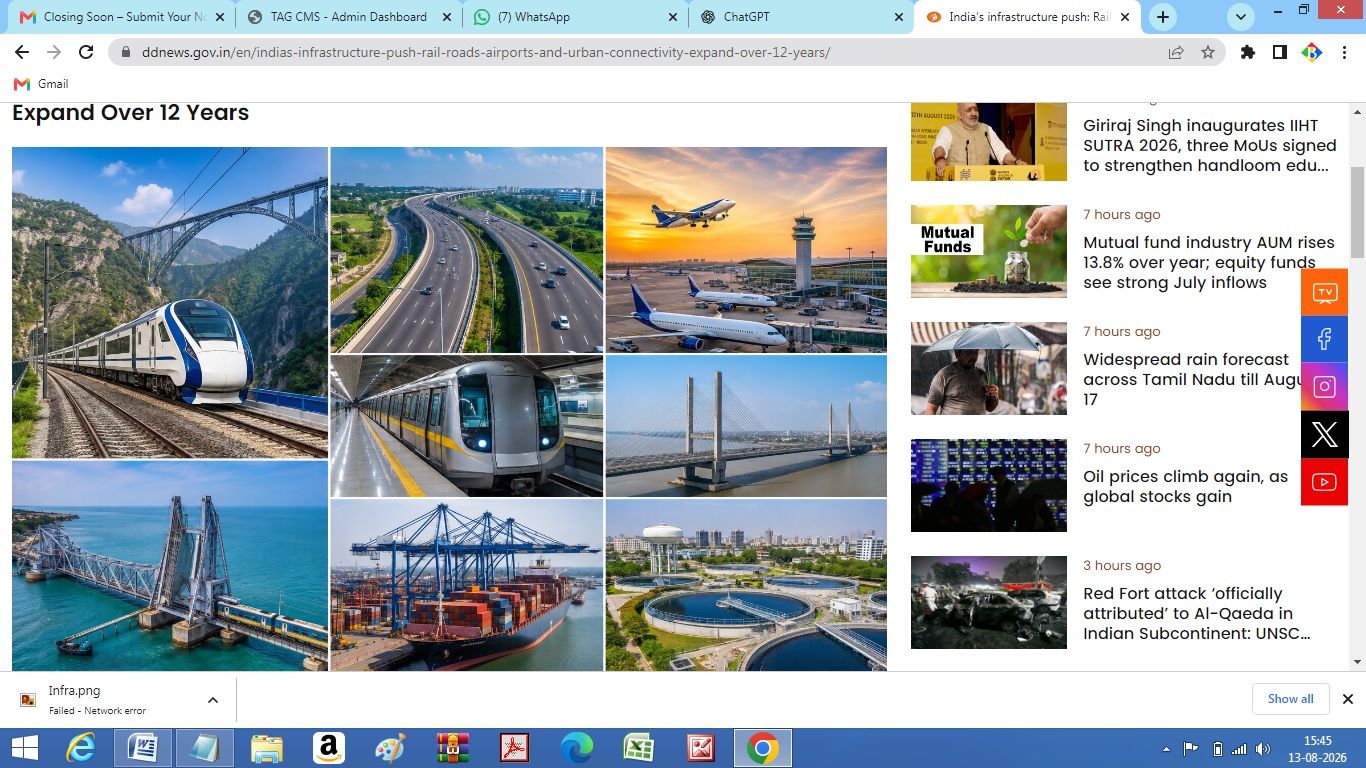
Indian Railways has been at the forefront of this
transformation. The railway budget has risen from Rs 32,000 crore in 2014-15 to
Rs 2.78 lakh crore in 2026-27, while electrification has reached 99.6% by July
2026, compared with around 20% before 2014. The network now has 162 Vande
Bharat trains, two Vande Bharat Sleeper services and 72 Amrit Bharat trains.
Kavach Version 4.0 has been commissioned across 2,633 route km.
The Mumbai-Ahmedabad High-Speed Rail Corridor, spanning 508
km with a design speed of 350 kmph, remains a flagship connectivity project.
Under the Amrit Bharat Station Scheme, 261 of 1,340 identified stations had
been redeveloped by July 18.
India has also entered new territory in green mobility, with
the launch in July of its first indigenously developed hydrogen fuel-cell
trainset. The 10-coach train can carry around 2,600 passengers and produces
water vapour and heat as its only by-products.
Road infrastructure has expanded in parallel. India’s road
network now stands at 63.73 lakh km, the world’s second-largest, while the
national highway network has grown about 61% to 1,46,572 km by March 2026.
Four-lane and wider highways have more than doubled to 45,516 km.
From the Chenab Bridge and Anji Khad Bridge to the Pamban
Bridge and strategic Himalayan tunnels, engineering projects are also extending
connectivity into some of the country’s most challenging terrain.
Aviation, urban transport and maritime infrastructure have
witnessed similar expansion. Operational airports have risen from 74 in 2014 to
165 in July 2026, while UDAN has connected 95 airports, heliports and water
aerodromes through 679 routes. Metro networks have expanded from 248 km to more
than 1,155 km, covering 26 cities.
At ports, cargo-handling capacity has nearly doubled to 1,728
million tonnes per annum, while vessel turnaround time has improved to 48.8
hours.
The transformation is increasingly being stitched together
through digital planning. PM GatiShakti integrates infrastructure planning
across 58 ministries and departments using more than 3,291 data layers. By
August 11, 396 projects worth about Rs 18.66 lakh crore had been evaluated
through the Network Planning Group.
The infrastructure push is also reaching households. Jal Jeevan Mission coverage has risen to around 15.91 crore rural households, while millions of homes have been completed under PMAY.
Taken together, the numbers point to a shift in India’s infrastructure strategy — from isolated asset creation to an integrated ecosystem designed to improve mobility, logistics, urban services and the broader competitiveness of the economy.