
Brings
advanced orthopaedic care closer to smaller cities
THEBUSINESSBYTES
BUREAU
FARIDABAD,
JUNE 19, 2026
In a landmark step
towards democratizing access to advanced orthopaedic care, Marengo Asia
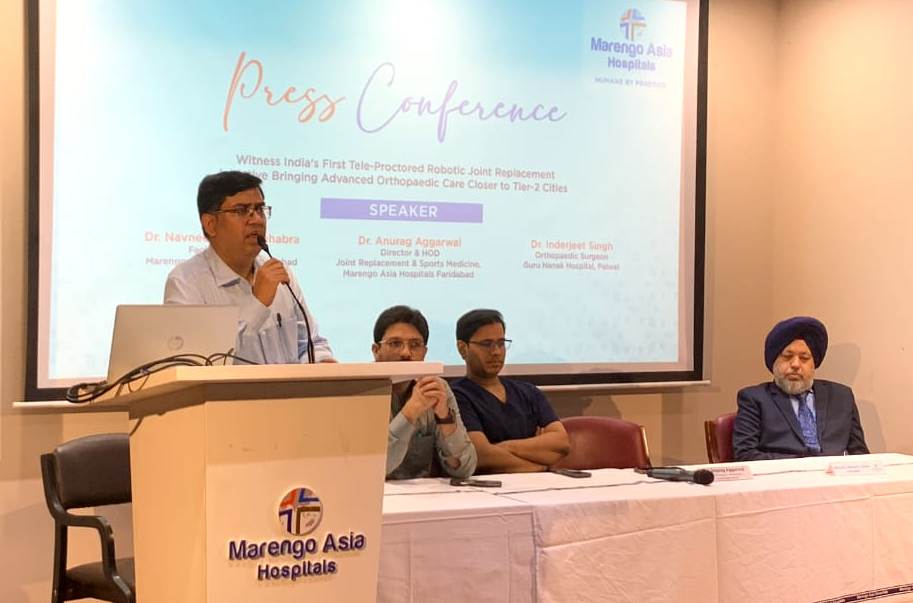
Hospitals, Faridabad, has introduced India’s first Tele-Proctor Robotic Surgery
Program for knee replacement procedures. The innovative initiative enables
expert robotic surgeons to remotely guide local surgeons in real time, making
cutting-edge robotic-assisted knee replacement surgery accessible to patients
in Tier-II and Tier-III cities while reducing travel costs and improving
treatment outcomes.
As robotic-assisted
knee replacement continues to redefine orthopedic care through greater
precision and faster recovery, tele-proctoring is emerging as a transformative
solution for bridging healthcare gaps. The mentorship-driven program is designed
to provide patient-centric, home-based care by allowing experienced robotic
surgeons to supervise complex procedures remotely, ensuring safety, accuracy,
and clinical excellence.
The effectiveness of
the initiative was recently demonstrated when a 67-year-old woman from Palwal,
Haryana, successfully underwent a tele-proctored robotic knee replacement
surgery. The procedure was performed by Dr. Inderjeet Singh at his hospital in
Palwal under real-time remote guidance from Dr. Anurag Aggarwal, who was stationed
at Marengo Asia Hospitals, Faridabad.
Dr. Anurag Aggarwal,
Clinical Director and Head - Orthopaedics & Robotic Joint Replacement,
Marengo Asia Hospitals, said, “Today Tele-Proctoring is bridging the gap
between technical training and real-world surgical mastery by directing
surgeons through live procedures under the supervision of experienced robotic
experts. During robotic knee replacement procedures, it significantly improves
surgeon confidence, procedural accuracy, and overall patient experience."
Dr. Anurag Aggarwal
further added, “We as proctor have operated on 3-4 cases of knee replacement
using robotic technology in cities like Palwal and So on. This new advancement
is called ‘Tele-Proctorship’ where a skilled Robotic surgeon can perform a surgery
from a distance. This new advancement is a win-win situation for the patient as
well as the surgeon. One of the main challenges of robotic joint surgery is
Pre-operative planning (It decides the limb alignment, implant sizing and
implant positioning) and calculating the Gap Balancing (It gives stability to
knee during full range of movement) which actually proves the outcome of the
surgery. In Tele-Proctorship the skilled surgeon performs all these from a
distance and the outcome is also positive."
Highlighting the
significance of the initiative, Dr. Navneet Singh Chhabra, Facility Director,
Marengo Asia Hospitals, Faridabad, added, “We are proud to offer specialized
services like Tele-proctoring for treating patients suffering from knee joint
problems in tier2 and tier 3 cities. This achievement reflects our continuous
focus on transforming the lives of people and providing them quality of life
through world-class healthcare services and clinical expertise. We are
committed to deliver advanced, safe, and patient-centric care. Our vision is to
make these services available to patients across the globe.”
Dr. Inderjit Singh,
Orthopaedic Surgeon, Gurunanak Hospital, Palwal, said, “Being part of this
tele-proctored robotic knee replacement surgery marks a significant step
towards making advanced orthopaedic care accessible beyond metro cities. With
the support and guidance of experts through Tele-robotic technology, we were
able to deliver precision-driven treatment to the patient here in Palwal. This
achievement reflects how innovation and collaboration can bridge healthcare
gaps and improve patient outcomes.”
Tele-proctoring
leverages advanced telecommunications technology integrated with fully
automated robotic platforms such as MISSO, enabling real-time surgical
guidance, secure connectivity, and enhanced procedural precision. The
technology allows expert surgeons to remotely monitor and support operations
with exceptional accuracy, paving the way for wider adoption of robotic surgery
in smaller cities and underserved regions.
The initiative marks
a significant milestone in India's healthcare landscape, demonstrating how
digital innovation and robotic technology can expand access to world-class
surgical expertise, regardless of geography. As tele-proctored robotic
procedures gain momentum, they have the potential to transform orthopaedic care
delivery across the country and bring advanced treatment options closer to
patients' homes.