THEBUSINESSBYTES
BUREAU
BHUBANESWAR,
APRIL 29, 2026
Union
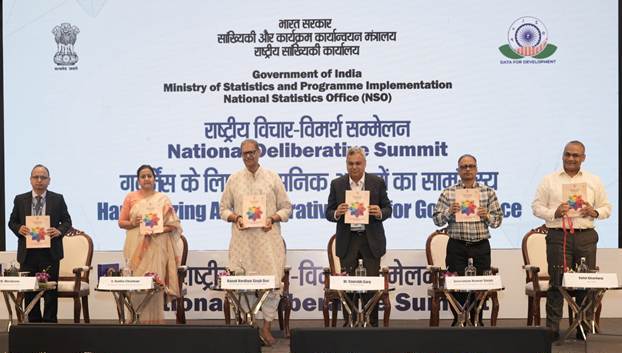
Ministry of Statistics and Programme Implementation (MoSPI), on Wednesday
released the 27th edition of its flagship publication, “Women and Men in India
2025: Selected Indicators and Data”, at the National Deliberative Summit on
“Data for Development” in Bhubaneswar.
The
publication presents a comprehensive overview of the status of women and men in
India through a compilation of selected indicators across key domains,
including population, education, health, economic participation,
decision-making, violence against women, and other gender-related issues. It
draws upon data from various Ministries, Departments, and organisations,
offering a robust statistical foundation for understanding gender dynamics
across the country.
A
notable addition to this edition is the inclusion of metadata for 50 key
indicators, designed to enhance clarity and facilitate a better understanding
of the concepts, definitions, sources, and methodological aspects underlying
the statistics presented.
Based
on official statistics, the publication provides gender-disaggregated data
across a wide range of themes. Several indicators have been presented by
rural-urban classification, State and Union Territory, and, wherever available,
over time, thereby enabling a deeper understanding of evolving gender
disparities and development trends across India.
By
analysing key socio-economic indicators and highlighting emerging trends, the publication
equips policymakers, researchers, and other stakeholders with valuable evidence
to formulate gender-responsive policies and programmes aimed at promoting
inclusive and sustainable development.
The
latest edition highlights several encouraging trends. The sex ratio at birth
has improved at the national level, rising from 904 in 2017-19 to 917 in
2021-23, indicating better survival rates among female children. Infant
mortality rates for both girls and boys have recorded a pronounced and sustained
decline between 2008 and 2023.
India
has also achieved gender parity across all levels of school education, from
Primary to Higher Secondary. In higher education, the Gross Enrolment Ratio has
improved from 28.5 to 30.2 for females and from 28.3 to 28.9 for males between
2021-22 and 2022-23.
The
report further points to significant gains in workforce participation. Labour
Force Participation Rate (LFPR) for persons aged 15 years and above has
increased for both men and women. Rural women, in particular, have witnessed
the sharpest rise, with LFPR climbing from 37.5 per cent in 2022 to 45.9 per
cent in 2025.
Women
are also making remarkable strides in leadership roles. Between 2017 and 2025,
the number of women engaged in managerial positions surged by an impressive
102.54 per cent, outpacing the 73.80 per cent increase recorded among men
during the same period.
The
publication reaffirms India's steady progress towards gender equality and
underscores the critical role of data-driven policymaking in fostering a more
inclusive and equitable society.