THEBUSINESSBYTES
BUREAU
BHUBANESWAR, JANUARY 29, 2026
In a
significant step towards aligning economic growth with environmental
stewardship, the Odisha State SDG Cell of the Planning and Convergence
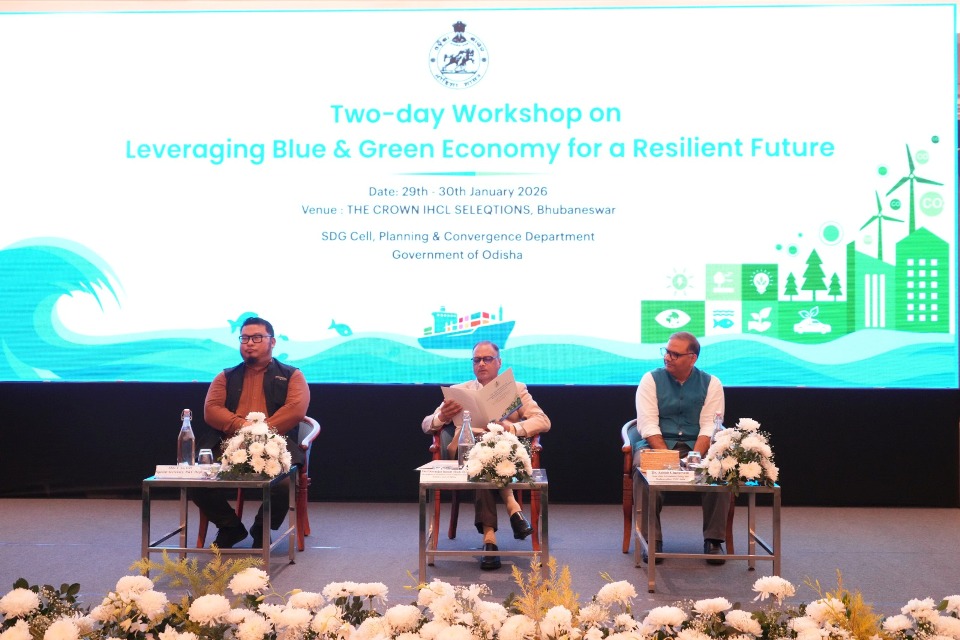
Department on Thursday inaugurated a two-day workshop titled “Leveraging Blue
and Green Economy for a Resilient Future” in Bhubaneswar. The high-level
deliberations, being held from January 29 to 30 at a city hotel here, aim to
integrate blue and green economy frameworks to strengthen climate resilience,
foster inclusive growth and advance the state’s long-term development vision of
Viksit Odisha @2036.
The workshop
has brought together a diverse and influential group of stakeholders, including
senior policymakers, experts from leading national institutions, academia, UN
agencies, civil society organisations, private sector representatives and
community leaders. The convergence reflects Odisha’s intent to build a
collaborative roadmap where sustainability, innovation and economic opportunity
reinforce one another.
 Delivering
the keynote address during the inaugural session, Odisha’s Development
Commissioner Deoranjan Kumar Singh underscored the critical role of
environmental sustainability in shaping future-ready economies. He highlighted
how green economy principles can unlock new growth avenues while safeguarding
natural resources.
Delivering
the keynote address during the inaugural session, Odisha’s Development
Commissioner Deoranjan Kumar Singh underscored the critical role of
environmental sustainability in shaping future-ready economies. He highlighted
how green economy principles can unlock new growth avenues while safeguarding
natural resources.
Complementing
this perspective, Dr. Ashish Chaturvedi, Head of the Environment, Energy and
Resilience pillar at UNDP India, New Delhi, spoke on India’s commitment to the
UN Sustainable Development Goals and the transformative potential of blue and
green economy frameworks in achieving them.
Structured
around six technical sessions with participation from 21 eminent speakers, the
workshop is examining key dimensions of sustainable development, climate
resilience and livelihood security. Experts from institutions such as NITI
Aayog, TISS, ICAR–IIWM, IIT Bhubaneswar, Berhampur University, MPEDA and UNDP
India, along with community-based organisations, are sharing policy insights,
research findings and best practices relevant to India and coastal states like
Odisha.
The first
day of the workshop focused extensively on the green economy, with in-depth
discussions on green jobs, environmental financing, water security and
responsible consumption and production. These deliberations are expected to
strengthen Odisha’s SDG implementation framework by aligning policy priorities
with innovation and community-led action.
In the
opening technical session, Dr. Neelam Patel, Senior Advisor (Agriculture), NITI
Aayog, and Ashok Singha, Managing Director, ASCERT Network Advisors, Odisha,
examined sustainable blue and green economic growth from an Indian perspective,
highlighting opportunities for coastal states amid challenges related to
climate change and energy security.
The second
session centred on sustainable climate-smart agriculture and inclusive
approaches, with insights from Nitin Bassi of CEEW, Dr. Bibhu Prasad Nayak of
TISS Hyderabad and Member of the 6th State Finance Commission, Odisha, and Dr.
Debal Deb, noted practitioner of indigenous seed conservation from Rayagada.
The third
technical session explored multiple pillars of the green economy, focusing on
water security, emerging technologies and green value chains. Dr. A. Sarangi,
Director, ICAR–IIWM, Bhubaneswar, Amit Kumar of Skyvan Aviation and Dr. M.K.
Ram Mohan, Director, MMEDA, Kochi, highlighted futuristic perspectives on
technology adoption and responsible production and consumption patterns.
The
inaugural day witnessed the participation of several senior government
officials, including S.K. Vashisth, Principal Secretary, Fisheries and Animal
Resources Development Department, Rajesh Pravakar Patil, Secretary, Cooperation
Department, and Mansi Nimbhal, Additional Secretary-cum-Managing Director,
OLIC, along with officers from the Planning and Convergence Department. An
audio-visual film on the Sustainable Development Goals was screened during the
event, and a booklet titled “Aspirational, Sustainable Snippets of Success from
the Heartland – Volume 2” was released, showcasing grassroots success stories.
The
inaugural session concluded with a vote of thanks proposed by Alka Jena,
Director, SDG Cell, Planning and Convergence Department.