THEBUSINESSBYTES
BUREAU
BHUBANESWAR,
MARCH 18, 2026
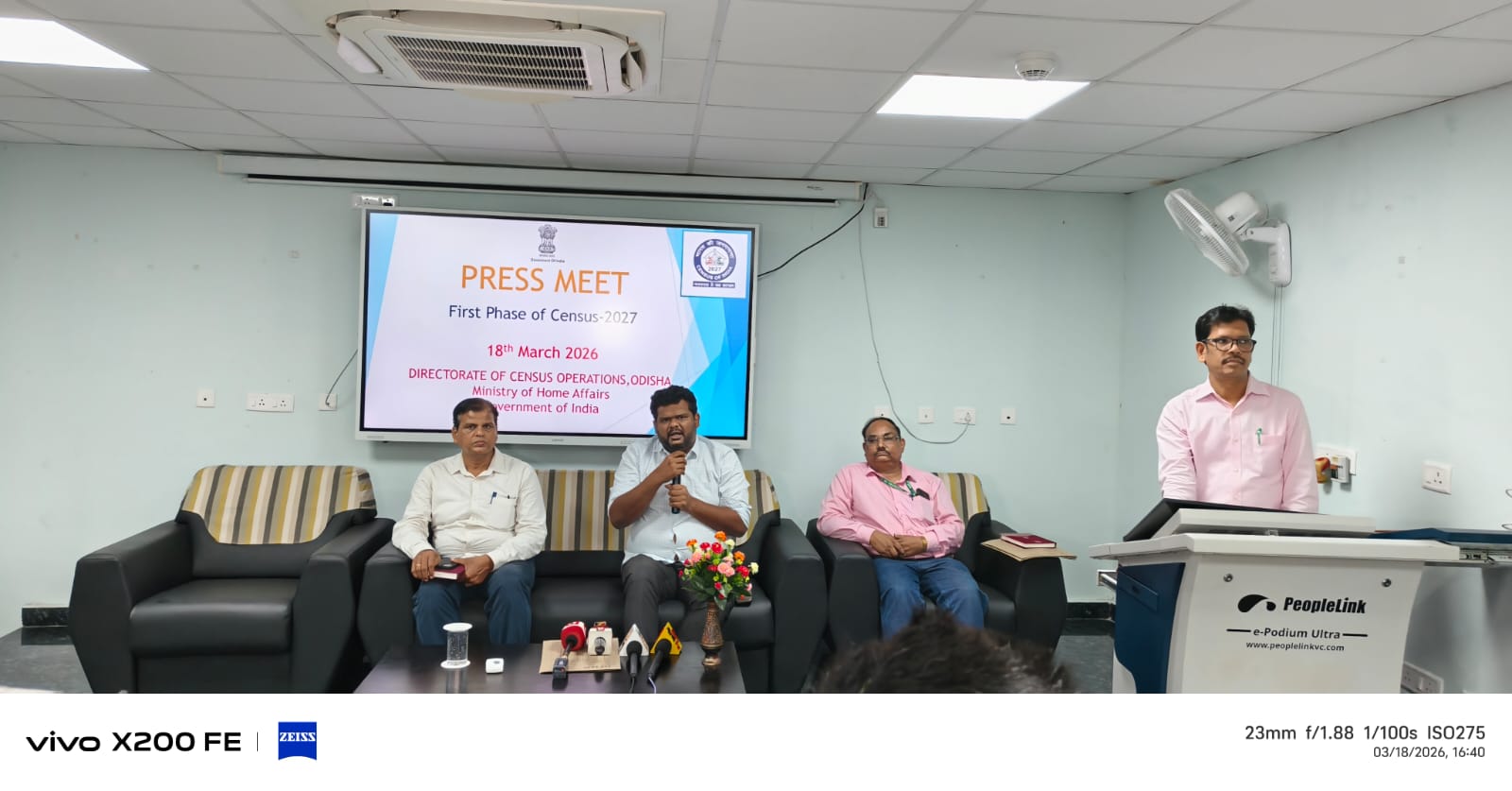
In a landmark step towards modernising
population data collection, the Directorate of Census Operations, Odisha under
the Ministry of Home Affairs, Government of India, in coordination with the
state’s Revenue and Disaster Management Department, is set to roll out the
first phase of the Census — House Listing Operations (HLO) — across all 30
districts of Bhubaneswar from April 16. The exercise, which will continue till
May 15, 2026, will see trained enumerators and supervisors visiting households
to gather crucial demographic and housing data.
In a first for the country, citizens
will also have the option to participate through self-enumeration before field
operations begin. The Self-Enumeration Portal (SE) will be open from April 1 to
midnight of April 15, enabling individuals to submit their information
digitally, which will later be verified during door-to-door visits.
 To ensure smooth execution of this
massive exercise, extensive training has been undertaken. A total of 67 Master
Trainers have been trained at the Gopabandhu Administrative Academy in two
phases. These trainers have further cascaded the training to 1,552 Field
Trainers, who are now equipping a vast workforce of 100,875 Enumerators and
17,282 Supervisors across the state. The training covers urban and rural
regions, including 91 Notified Area Councils, 48 Municipalities, 5 Municipal Corporations,
and 2 Industrial Towns.
To ensure smooth execution of this
massive exercise, extensive training has been undertaken. A total of 67 Master
Trainers have been trained at the Gopabandhu Administrative Academy in two
phases. These trainers have further cascaded the training to 1,552 Field
Trainers, who are now equipping a vast workforce of 100,875 Enumerators and
17,282 Supervisors across the state. The training covers urban and rural
regions, including 91 Notified Area Councils, 48 Municipalities, 5 Municipal Corporations,
and 2 Industrial Towns.
The census operations will be
conducted using a dedicated mobile application, marking a shift from
traditional paper-based methods to a fully digital framework. Supporting this
transition, the CMMS Portal will be utilised for creating House Listing Blocks
(HLBs), reinforcing the efficiency and accuracy of the process.
Adding a creative and public
engagement dimension to the initiative, internationally acclaimed sand artist
and Padma Shri awardee Sudarshan Pattnaik has been roped in as the Brand
Ambassador to boost awareness and participation.
The administrative framework for the
census has been clearly defined, with District Collectors and Municipal
Commissioners serving as Principal Census Officers, while Additional District
Collectors will act as District Census Officers. At the grassroots level,
Executive Officers of Urban Local Bodies and Tahsildars will function as Charge
Officers under the supervision of District Collectors. The Revenue and Disaster
Management Department will act as the nodal authority for the programme.
A notable feature of this census is
the involvement of educators, with primary school teachers from the School and
Mass Education Department designated as Enumerators and high school teachers
taking on supervisory roles, ensuring both reliability and community
engagement.
This will be the first digital census
in India, and for the first time, there is a provision for self-enumeration in
the Indian Census. The data submitted through self-enumeration will be verified
again by Enumerators during field visit. The census will involve the use of the
CMMS Portal along with digital methods for creating House Listing Blocks
(HLBs).
The entire programme will span from
April 1 to May 15, with self-enumeration leading into the field-based
enumeration phase, marking a significant milestone in India’s journey towards a
technology-driven governance framework.