THEBUSINESSBYTES
BUREAU
NEW DELHI,
JUNE 3, 2026
In a significant breakthrough in
cancer nanomedicine, scientists from Pune have developed an innovative
gene-silencing strategy that effectively inhibits breast tumors, paving the way
for a new generation of precision nanomedicine with the potential to deliver
safer and more targeted cancer treatment.
Researchers from the Agharkar Research
Institute (ARI), Pune — an autonomous institute under the Department of Science
and Technology (DST), Government of India—have engineered a biodegradable
nanocarrier platform designed specifically for targeted gene therapy in breast
cancer.
The study, recently published in
Advanced Healthcare Materials, offers fresh insights into the targeted
silencing of critical survival pathways in breast cancer cells. By enabling
efficient tumor targeting and suppression, the technology presents a promising
avenue for developing more effective and less toxic nanomedicine-based
therapies.
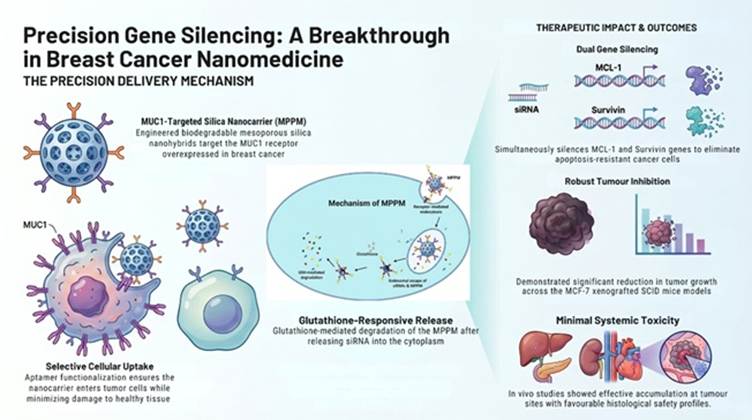
The platform is based on biodegradable
mesoporous silica nanoparticles, known for their high drug-loading capacity and
adaptable surface chemistry. These nanoparticles are designed to efficiently
transport small interfering RNA (siRNA) molecules. By functionalizing the
nanocarrier with a protamine biopolymer and an MUC1-specific aptamer, the
researchers achieved highly precise tumor targeting, taking advantage of the
overexpression of MUC1 receptors on breast cancer cells. This approach
significantly improves cellular uptake while minimizing off-target effects — one
of the major challenges in conventional cancer therapies.
A key highlight of the study,
conducted by Niladri Haldar, Rajkumar Samanta, Surajit Patra, Devyani Sengar,
Sachin Jadhav and Virendra Gajbhiye, is its dual gene-silencing strategy. The
nanocarrier simultaneously delivers siRNAs targeting two crucial anti-apoptotic
genes — MCL-1 and Survivin — both of which are known to support tumor growth
and resistance to treatment. Once inside the tumor microenvironment, the
glutathione-responsive system triggers the controlled release of the
therapeutic payload, ensuring efficient intracellular delivery and enhanced
therapeutic action.
Biological evaluations using MCF-7
breast cancer models demonstrated strong gene knockdown, leading to increased
cancer cell death and substantial inhibition of tumor growth. Importantly, in
vivo studies conducted on Severe Combined Immunodeficiency (SCID) mice revealed
effective accumulation of the nanocarrier at tumor sites with minimal systemic
toxicity, supported by favourable histological findings.
The findings reinforce growing
evidence that aptamer-guided nanocarriers can dramatically improve tumor specificity
and treatment efficacy. By integrating targeted delivery, stimuli-responsive
release and combinatorial gene silencing into a single biodegradable platform,
the researchers have demonstrated a powerful new approach to RNA interference
(RNAi)-based cancer therapy.
The study highlights the growing
potential of precision oncology, where therapies are tailored to attack
specific molecular drivers of disease. Such next-generation nanomedicine
platforms could eventually offer more effective and safer alternatives to
traditional chemotherapy, marking an important step forward in the fight
against breast cancer.
The research was carried out by
scientists from the Nanobioscience Group at the Agharkar Research Institute,
Pune.