
THEBUSINESSBYTES BUREAU
BHUBANESWAR, FEBRUARY 19, 2026
A field-based study has highlighted persistent employment challenges in
the KBK region, pointing to low non-farm job creation, continued dependence on
agriculture and high levels of distress migration, while also noting the
potential for job growth if approved projects are implemented on schedule.
The Ground Connect Initiative of PRAHAR – Public Response Against
Helplessness and Action for Redressal – which covered Kalahandi, Balangir,
Koraput, Nuapada, Rayagada and Nabarangpur, underscores the contrast between
the faster industrial expansion seen in parts of Coastal Odisha and the slower
pace of economic diversification in Western districts. The organisation said
the findings are based on village-level interactions, community consultations
and discussions with sector experts.
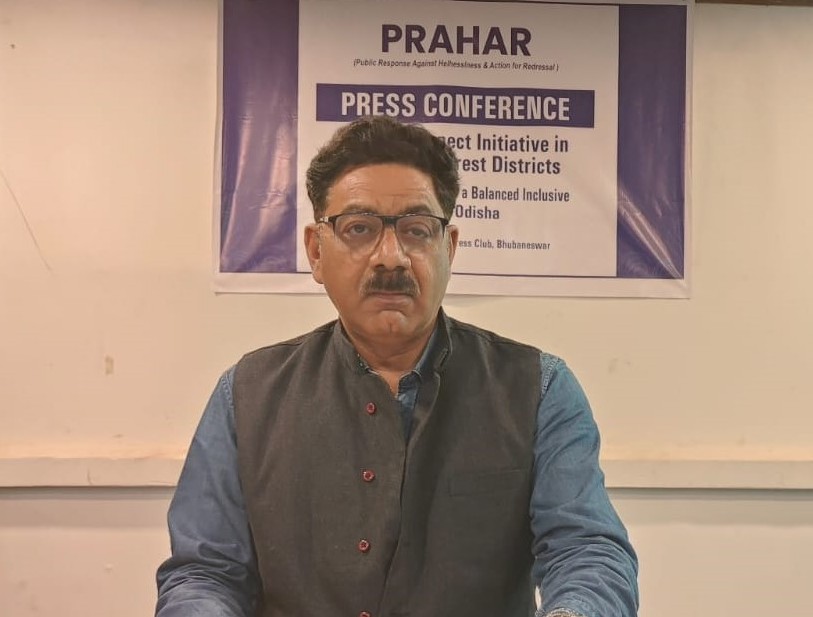
 According to PRAHAR President and National Convenor Abhay Raj Mishra,
“Families in Western Odisha today rely heavily on migration to make their ends
meet. People are leaving because there are no stable, formal jobs at home.
Welfare schemes help families survive, but they do not create dignity, security
or a future for the youth. There is an immediate need to re-think the
developmental strategy and focus on fast-tracking projects which have high
employment elasticity to reverse the trend.”
According to PRAHAR President and National Convenor Abhay Raj Mishra,
“Families in Western Odisha today rely heavily on migration to make their ends
meet. People are leaving because there are no stable, formal jobs at home.
Welfare schemes help families survive, but they do not create dignity, security
or a future for the youth. There is an immediate need to re-think the
developmental strategy and focus on fast-tracking projects which have high
employment elasticity to reverse the trend.”
He added, “We are not asking the government to invent new ideas. We are
asking to implement what is already approved. Jobs can be created if stalled
big ticket projects are unlocked now which are heavily invested and ready to
operate.”
The report notes that agriculture continues to employ a large share of
the workforce in the region, mostly in seasonal and low-income activities,
while formal sector opportunities remain limited. It cites significant income
disparities, with per capita income in districts such as Kalahandi estimated at
around ₹32,000
compared to the state average of nearly ₹1.8 lakh. Migration for work remains
widespread, with non-official estimates suggesting around 60,000 seasonal migrants from Kalahandi and over 28.16 lakh
migrant workers from across Odisha.
PRAHAR’s analysis suggests that existing approved industrial and
mining-linked projects could generate employment if implementation timelines
are adhered to. It estimates that about 35,000 jobs could be created in Western
Odisha, including around 25,000 within the current year, primarily through
operationalising projects that have already received clearances. At the same
time, it acknowledges that recently announced projects worth ₹4,111
crore, with a projected employment potential of 9,924 jobs, will take several
years to become operational.
The study also points to the relatively small MSME base in parts of the
region, noting that Kalahandi has around 200 MSMEs employing about 2,000
people. It suggests that strengthening local industrial ecosystems and
improving infrastructure, skill development and market linkages could enhance
employment density over time.
On the issue of mineral-based industries, the organisation said that
natural resource potential in Western Odisha could support local value chains
and generate revenues, while emphasising that any future development should be
aligned with statutory clearances, environmental safeguards and community
benefit frameworks already mandated under existing laws.
The report also observes that balanced regional development requires sustained public investment, improved connectivity, education and skill programmes, alongside industrial growth. It notes that government welfare schemes continue to play a significant role in income support and poverty reduction in the region, even as long-term employment generation remains a policy priority.
PRAHAR said it will submit its findings to the state government as part of a consultative process, urging time-bound execution of approved projects, expansion of MSME clusters and a stronger focus on employment-oriented planning. The organisation maintained that reducing distress migration and improving local livelihood opportunities would require coordinated action across government departments, industry and community institutions.