
THEBUSINESSBYTES
BUREAU
BHUBANESWAR, MARCH 25, 2026
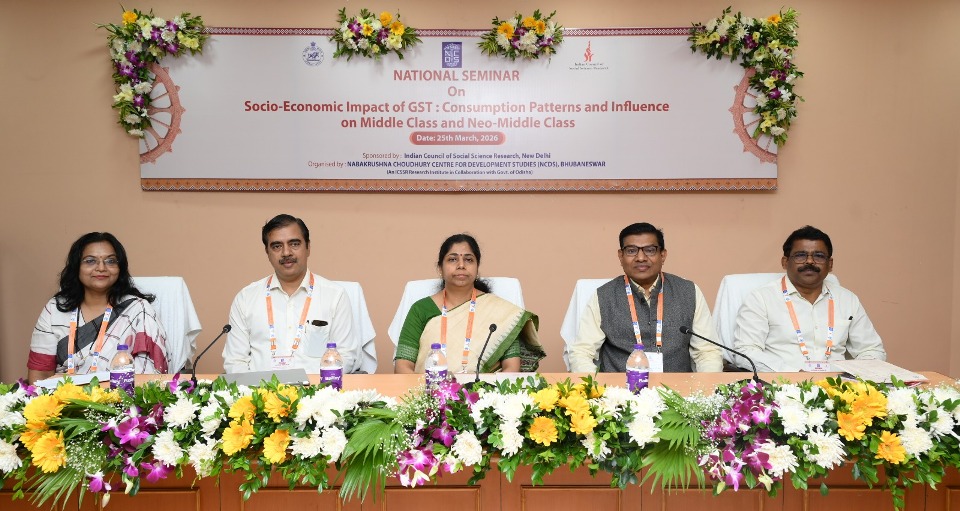
The Nabakrushna Choudhury Centre for
Development Studies (NCDS), Bhubaneswar, on Wednesday hosted a national seminar
titled “Socio-Economic Impact of Goods and Services Tax (GST): Consumption
Patterns and Influence on Middle Class and Neo-Middle Class,” bringing together
policymakers, economists, and academicians to deliberate on the evolving
influence of GST on India’s socio-economic landscape. The seminar underscored
the growing importance of analysing tax reforms not merely from a revenue
standpoint but through the broader lens of their impact on household behaviour,
consumption patterns, and economic resilience.
Held at the institute’s premises, the
event reaffirmed NCDS’s role as a key platform for development research and
policy dialogue.
 The inaugural session was graced by Yamini
Sarangi, Commissioner of CT&GST, Odisha, as Chief Guest; Prof. Sudhakar
Patra, RBI Chair Professor at Utkal University, as Guest of Honour; and Dr.
Satya Priya Rath, Additional Secretary, Finance Department, Government of
Odisha, as Special Guest.
The inaugural session was graced by Yamini
Sarangi, Commissioner of CT&GST, Odisha, as Chief Guest; Prof. Sudhakar
Patra, RBI Chair Professor at Utkal University, as Guest of Honour; and Dr.
Satya Priya Rath, Additional Secretary, Finance Department, Government of
Odisha, as Special Guest.
The programme commenced with a welcome
address by Prakash Chandra Mohanty, Director, NCDS, who highlighted the
importance of examining tax reforms beyond revenue metrics to understand their
wider social and economic implications. The inaugural session concluded with a
vote of thanks by Rashmi Kabi, Secretary, NCDS.
The seminar featured two technical
sessions that provided both academic and administrative perspectives. The first
session included the presentation of a research report by NCDS scholars,
offering insights into changing consumption patterns under GST. Expert lectures
by an RBI Chair Professor and an Associate Professor from IIT Bhubaneswar
provided theoretical perspectives on taxation and household economic behaviour,
enriching the discourse with analytical depth.
The second session focused on policy
implementation and administrative experience. The Joint Commissioner of
CT&GST, Odisha, shared practical insights on compliance and its
socio-economic implications, while a former NCDS professor reflected on the
long-term evolution of GST and its structural impact on the economy.
Discussions were marked by active engagement and constructive dialogue among
participants, reflecting the relevance of GST in shaping contemporary economic
realities.
The valedictory session synthesized
key insights on middle-class resilience and the need for inclusive tax policy
frameworks. Concluding remarks were delivered by the Secretary, NCDS, followed
by felicitation of guests led by the Director.
The seminar concluded with a vote of
thanks by Dr. Biswabas Patra, Convenor, and ended on a note encouraging
continued academic and policy interaction. Overall, the seminar reinforced
NCDS’s commitment to fostering informed policy discourse and advancing research
on contemporary economic challenges impacting India’s middle and neo-middle
classes.