
THEBUSINESSBYTES
BUREAU
JAJPUR, MARCH 24, 2026
For 34-year-old Bhagirathi Swain of
Raitikar village in Sukinda block under Pingala Gram Panchayat, farming was
never merely a tradition; it was a passion waiting to take shape. A
professional executive engineer, he turned to agriculture with renewed purpose
during the COVID-19 pandemic, a period that reshaped perspectives on livelihoods
and self-reliance.
Managing nearly six acres of land,
including his own and family holdings, Bhagirathi cultivated crops such as
paddy, groundnut, pointed gourd, and vegetables, earning around ₹3 lakh annually. However, he aspired to move beyond conventional
farming and explore more rewarding opportunities.
A major turning point came when he was
introduced to modern horticulture practices through the Horticulture
Department, Government of Odisha, in collaboration with Tata Steel Foundation.
With their guidance and support, he ventured into strawberry cultivation, a
relatively new high-value crop in the region.
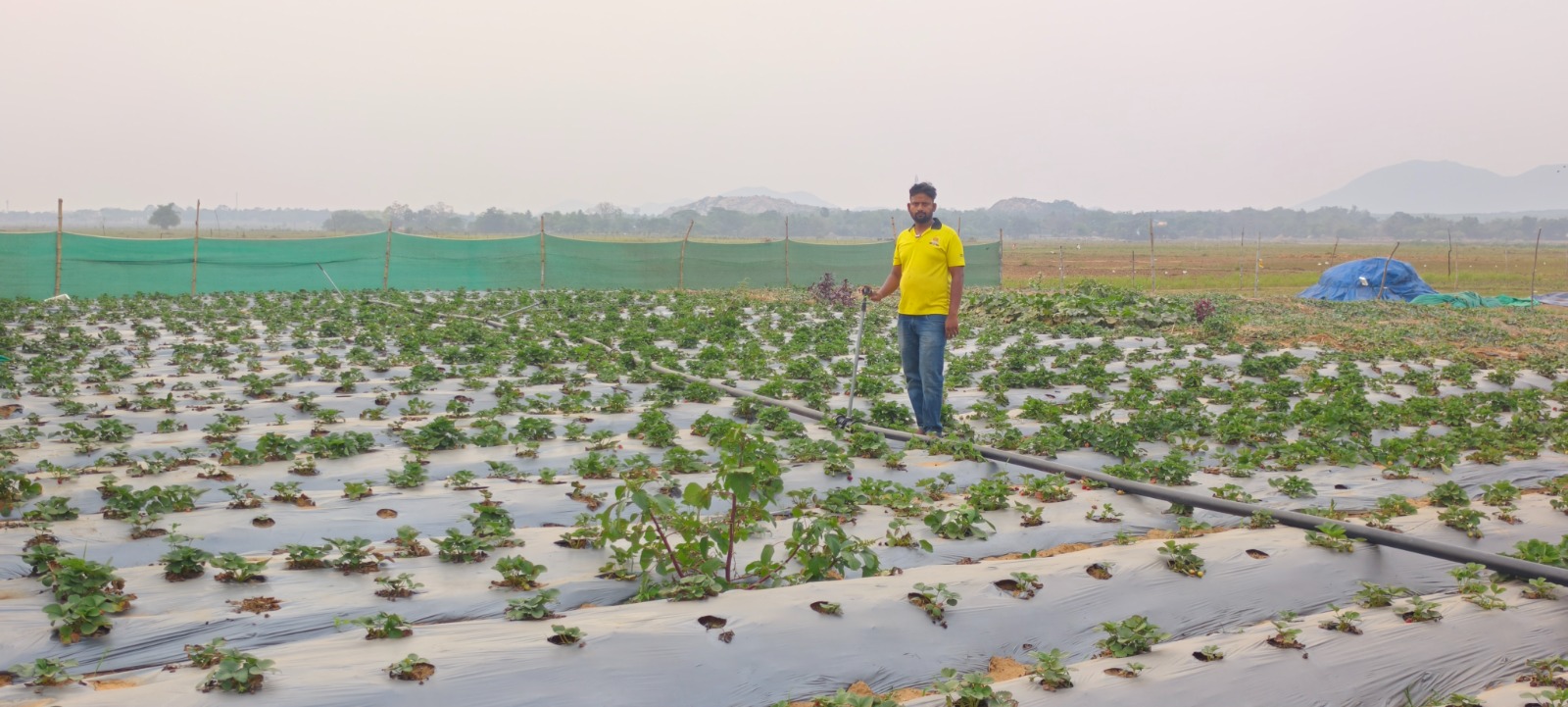
 On 48 decimals of land, Bhagirathi
planted nearly 10,000 strawberry saplings. Support from the government and Tata
Steel Foundation, including planting materials, mulching sheets, and trellis
nets, significantly reduced his initial investment burden.
On 48 decimals of land, Bhagirathi
planted nearly 10,000 strawberry saplings. Support from the government and Tata
Steel Foundation, including planting materials, mulching sheets, and trellis
nets, significantly reduced his initial investment burden.
“I always wanted to try something new in
farming, but the support from Tata Steel Foundation and the Horticulture
Department gave me the confidence to take this step,” he says.
The results have been encouraging.
With an investment of around ₹47,000,
he has already earned close to ₹1 lakh and expects total returns to exceed ₹2.5
lakh by the end of the harvest season. Selling strawberries at about ₹250 per kg in local markets such as Duburi and Danagadi,
he is now earning nearly ₹95,000 per month during the peak harvest period.
His success is inspiring others in the
community as well. Through the Mahabir Krushak Sangha, a farmer group supported
by Tata Steel Foundation, Bhagirathi is motivating fellow farmers to adopt
innovative crops and modern agricultural practices.
“Strawberry farming has shown me that with the
right support, farmers can improve both income and confidence,” he adds.
Sharing his perspective, Debanjan
Mukherjee, Head – Kalinganagar Impact Cluster, Tata Steel Foundation, says, “We
are working to promote high-value crops that improve farmer incomes and build
resilience, while maintaining a balance between industrial and agrarian
growth.”
Looking ahead, Bhagirathi plans to
diversify into value-added activities such as establishing a mini oil
processing unit, while continuing to experiment with new crops. Despite
challenges such as water availability, he remains committed to innovation-led
farming.
Bhagirathi Swain’s journey reflects
how the right support, knowledge, and determination can transform agriculture
into a sustainable and rewarding livelihood. Through such initiatives, Tata
Steel Foundation continues to empower farmers to adopt high-value agriculture
and build resilient rural communities.