THEBUSINESSBYTES
BUREAU
RAJGIR,
MARCH 31, 2026
Emphasising the
transformative power of knowledge in shaping the nation’s future, President
Droupadi Murmu on Tuesday said that institutions like Nalanda University will
play a vital role as India moves towards becoming a developed nation by 2047.
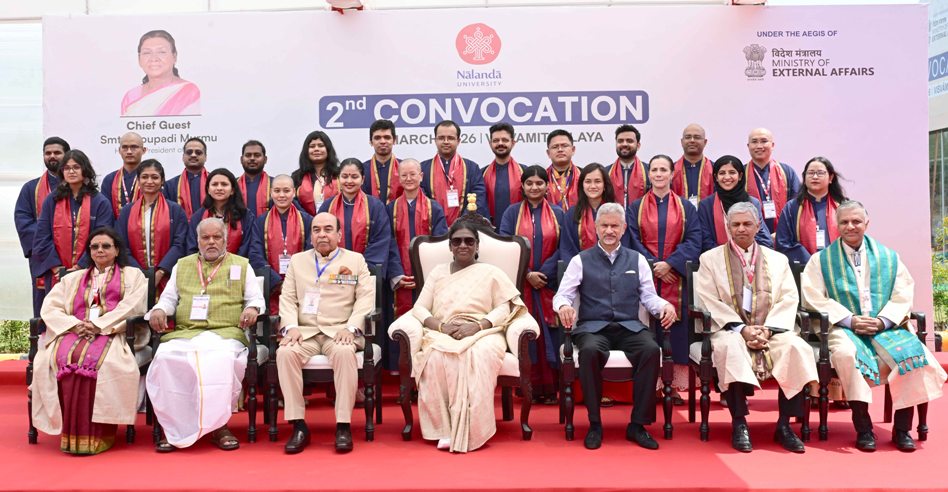
Addressing the convocation ceremony of the University at Rajgir, Bihar, the
President highlighted that the revival of Nalanda reflects a civilizational
commitment to learning, dialogue and global cooperation rooted in shared
values.
Speaking on the
occasion, the President described the convocation as a reaffirmation of a
timeless promise — that knowledge endures, dialogue prevails, and education
continues to serve humanity. Congratulating the graduating students, she noted
that their success reflects perseverance, discipline and intellectual
commitment. She expressed happiness that more than half of the graduating
cohort comprised international students representing over 30 countries,
reflecting the global appeal of the institution.
 Recalling the legacy
of the ancient Nalanda University, the President said it remained a
distinguished centre of learning for nearly eight centuries, attracting
scholars from across the world. Its decline, she observed, was a profound loss
not only for India but for global knowledge traditions. However, the enduring
idea of Nalanda continued to inspire generations, and its revival symbolises a
collective national and international resolve to restore that glorious
tradition in a modern form.
Recalling the legacy
of the ancient Nalanda University, the President said it remained a
distinguished centre of learning for nearly eight centuries, attracting
scholars from across the world. Its decline, she observed, was a profound loss
not only for India but for global knowledge traditions. However, the enduring
idea of Nalanda continued to inspire generations, and its revival symbolises a
collective national and international resolve to restore that glorious
tradition in a modern form.
She emphasised that
the resurgence of Nalanda has been made possible through visionary leadership,
sustained institutional efforts and the cooperation of partner nations.
According to the President, this stands as an example of how countries can work
together to achieve shared aspirations guided by common values.
Highlighting the
spirit of intellectual openness that defined ancient Nalanda, the President
said the institution historically welcomed diverse schools of thought and
encouraged debate and dialogue. Knowledge, she noted, was never pursued in
isolation but was deeply connected to ethics, society and the welfare of
humanity. She stressed that this approach remains highly relevant today,
particularly at a time when the world is confronted with complex global
challenges requiring critical thinking anchored in compassion and
responsibility.
The President also
underlined India’s deep and living connection with Buddhist philosophy and
traditions, noting that this intellectual heritage must be nurtured with
seriousness and a holistic understanding of India’s classical knowledge
systems. She expressed confidence that Nalanda University can emerge as a
leading global centre for Buddhist studies, rooted in India’s civilizational
foundations while engaging with diverse Asian traditions. She urged the institution
to invest in this field with depth, openness and commitment, thereby fulfilling
a role that dates back centuries.
Referring to the
legendary library of ancient Nalanda, believed to have housed millions of
manuscripts, the President said the modern institution has the opportunity to
create an equally enduring legacy for future generations. She reiterated that
as India advances towards becoming a developed nation by 2047, institutions
like Nalanda University will play a crucial role in shaping knowledge-driven
growth, fostering global understanding and strengthening India’s intellectual
leadership on the world stage.