THEBUSINESSBYTES BUREAU
BHUBANESWAR, FEBRUARY 19, 2026
Odisha has scripted a compelling growth narrative, with its economy
closing in on the ₹10 lakh crore milestone and expanding faster than
the national average, according to the Economic Survey 2025-26. The survey
paints a picture of broad-based development driven by robust agriculture,
rising industrial investments, expanding services, strong fiscal management and a significant surge in women’s
workforce participation.
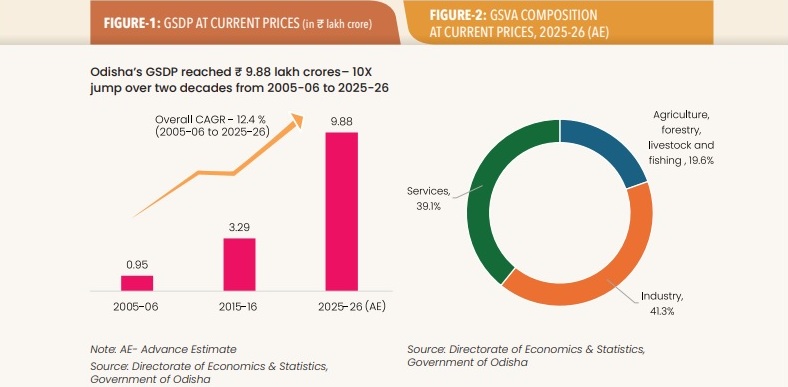
The state’s Gross State Domestic Product (GSDP) at current prices is
estimated at ₹9.9 lakh crore in 2025-26, marking a 9.5 per cent
increase from ₹9 lakh crore in the
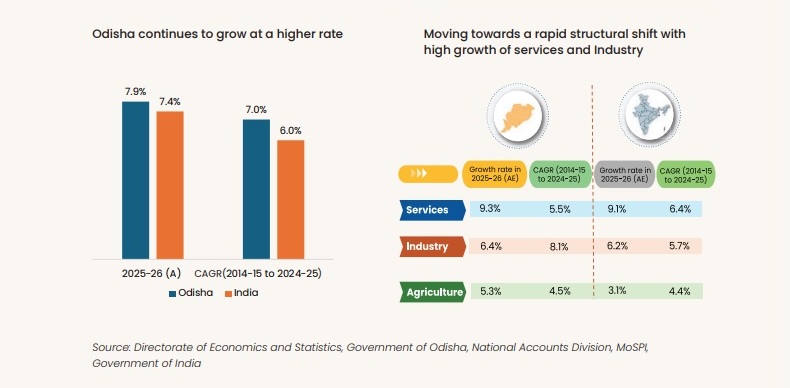
previous year. In real terms, Odisha’s economy is projected to grow at 7.9 per
cent, higher than last year’s 7.2 per cent and above the national average of
7.4 per cent, reflecting sustained momentum across sectors supported by both
public and private investment.
Per capita income has risen by 9.2 per cent to ₹1,86,761,
outpacing the national growth rate of 6.9 per cent and signalling faster
convergence with all-India income levels. Labour force participation has also
improved sharply, reaching 64.5 per cent in 2024 compared with the national average of 59.6 per cent. Notably, female
participation has jumped to 48.7 per cent, well above the all-India figure of
40.3 per cent, underlining the impact of livelihood programmes, workplace
reforms and social support systems.
 Agriculture continues to remain a key pillar, contributing 19.6 per cent
to the state economy, significantly higher than the national average. The
sector recorded 5.3 per cent growth, aided by crop diversification into cotton,
maize, vegetables and spices. Foodgrain production touched a record 150.5 lakh
metric tonnes in 2024-25, including 118.6 lakh tonnes of rice, while
procurement operations benefitted around 20 lakh farmers with payments
exceeding ₹28,000 crore through MSP and input subsidies. Expansion of irrigation potential to 74.2 lakh hectares
and an increase in cropping intensity to 165 per cent have further strengthened
rural incomes. Allied sectors such as dairy, poultry and fisheries are also
gaining traction, with Odisha emerging as the country’s fourth-largest fish
producer and third-largest marine exporter.
Agriculture continues to remain a key pillar, contributing 19.6 per cent
to the state economy, significantly higher than the national average. The
sector recorded 5.3 per cent growth, aided by crop diversification into cotton,
maize, vegetables and spices. Foodgrain production touched a record 150.5 lakh
metric tonnes in 2024-25, including 118.6 lakh tonnes of rice, while
procurement operations benefitted around 20 lakh farmers with payments
exceeding ₹28,000 crore through MSP and input subsidies. Expansion of irrigation potential to 74.2 lakh hectares
and an increase in cropping intensity to 165 per cent have further strengthened
rural incomes. Allied sectors such as dairy, poultry and fisheries are also
gaining traction, with Odisha emerging as the country’s fourth-largest fish
producer and third-largest marine exporter.
Industry remains the largest contributor to GSVA at 41.3 per cent, with
manufacturing growth projected at 8.3 per cent, higher than the national
average. The approval of 244 new projects in 2025 with proposed investments of ₹5.66 lakh
crore and the implementation of 80 projects generating 1.4 lakh jobs underscore
strong investor confidence. Business reforms, including a 98 per cent
implementation rate under BRAP 2024 and the Odisha Jan Vishwas Bill 2025, have simplified compliance and
improved the ease of doing business.
The services sector, accounting for 39.1 per cent of GSVA, is expected to
grow by 9.3 per cent, led by financial services and emerging digital policies
on artificial intelligence, global capability centres and semiconductors,
positioning the state for technology-driven expansion.
Fiscal indicators remain among the strongest in the country, with the
capital outlay-to-GSDP ratio budgeted at 6.6 per cent, a low debt-to-GSDP ratio
of 13.6 per cent and modest interest payment obligations, ensuring
sustainability while supporting high infrastructure spending.
Major investments in ports, railways and aviation are enhancing
connectivity and logistics efficiency. Paradip port alone handled about 18 per
cent of India’s cargo in 2024-25, while non-major port capacity is set for a
significant expansion. Rail network growth, rising passenger traffic and
improved air connectivity to 30 cities are reinforcing Odisha’s role as an emerging
logistics hub.
Social sector spending has also expanded substantially. Public health expenditure has more than tripled since 2019-20, school education funding has risen sharply with widespread internet access in schools, and skill development initiatives are delivering high placement rates. Programmes promoting women’s economic empowerment, SC/ST participation in higher education and industrial employment, and youth development through sports infrastructure are contributing to inclusive growth.
The Economic Survey underscores that Odisha’s development is no longer confined to resource-led expansion but is increasingly powered by human capital, infrastructure, technology and institutional reforms, positioning the state as one of India’s fastest-growing and fiscally resilient economies.