
ASSOCHAM’s
O-LEADS 2026 calls for stronger industry-academia-startup collaboration to
drive Odisha’s growth
THEBUSINESSBYTES
BUREAU
BHUBANESWAR,
OCTOBER 9, 2026
Don’t look at
startups only as vendors but treat them as innovation partners to address real
business challenges and accelerate industrial growth, Odisha Industries and
Skill Development and Technical Education Minister Sampad Chandra Swain said on
Friday.
Addressing the
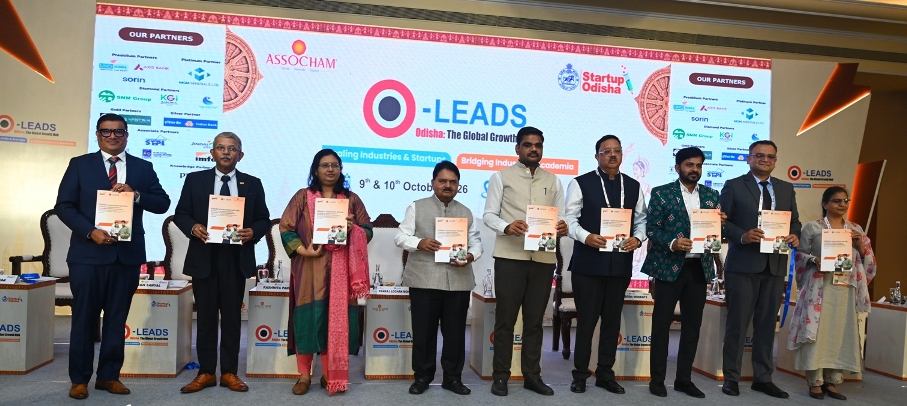
inaugural session of ASSOCHAM’s two-day conclave, O-LEADS 2026 – Odisha: The Global Growth Hub, here, Swain
emphasised the need for stronger collaboration among industry, academia,
startups and the government to translate investments into employment
opportunities, innovation and sustainable economic growth.
“Don’t look at startups only as vendors. Look
at them as innovation partners,” he said, urging industries to identify specific
business and operational challenges and engage startups to develop practical
solutions.
Stressing the need to
bridge the gap between innovation and commercialisation, Swain called for
greater industry support for startups through pilot projects, mentorship,
testing facilities and market access. Such collaboration would help
entrepreneurs move beyond the incubation stage and turn their ideas into
commercially viable products and services, he said.
The minister also
underscored the importance of industry participation in curriculum design,
internships, apprenticeships, faculty development and workforce planning to
equip young people with skills required by emerging sectors, including
semiconductors, advanced manufacturing, electronics, automation and green
energy.
The conclave,
organised by the Associated Chambers of Commerce and Industry of India
(ASSOCHAM) on October 9 and 10, brought together government representatives,
industry leaders, entrepreneurs and academic institutions to explore
opportunities for strengthening Odisha’s startup ecosystem and accelerating
industrial development.
Pankaj Lochan
Mohanty, Chairman of ASSOCHAM’s Odisha State Development Council and CMD of MGM
Group, said the state’s ambition should extend beyond creating a
startup-friendly environment to building an ecosystem where startups emerge,
enterprises scale, industries innovate and Odisha-based businesses compete in
global markets.
“Our vision goes beyond making Odisha merely
startup-friendly; we must build an ecosystem where startups are born,
enterprises scale, industries innovate, and Odisha-born businesses compete
globally,” he said.
Rashmita Panda,
Commissioner-cum-Secretary of the MSME Department, Odisha government,
highlighted the need for closer alignment among policy, academia and industry
to enable startups to expand their operations and compete globally.
She also highlighted
the role of the proposed new Startup Policy, equity funding and industry
collaboration in supporting entrepreneurs and strengthening the state's innovation
ecosystem.
Abanis Nayak,
Chairman of ASSOCHAM’s Odisha State Startup Council, said innovation would be a
key driver of Odisha’s next phase of economic development. He expressed
confidence that coordinated efforts by the government, industry and academia
would help the state realise its vision of a “Samruddha Odisha” before 2036.
Prabodh Mohanty,
Co-Chair of ASSOCHAM’s Odisha State Development Council and Managing Director
of SNM Group, stressed that startups must focus on solving real commercial and
industrial problems.
He called for a
stronger pathway from ideas to products, customers, scale and global markets,
saying such an approach would be crucial to Odisha’s ambition of becoming a USD
500 billion economy by 2036.
Alexander Das,
Chairman of ASSOCHAM’s Odisha State Education Council and Chairman of Kalinga
Group of Institutions, emphasised the need to combine industrial challenges
with entrepreneurial mentorship, investment and academic talent to develop
solutions to global problems.
Debankur Ghosh, Co-Chair of the IT and Emerging Tech Council and Partner at PricewaterhouseCoopers (PwC), called for deeper industry-academia collaboration to convert research into high-impact innovation.
The two-day conclave focuses on scaling industries and startups, commercialising research and strengthening partnerships between industry and academic institutions. The programme's inaugural session concluded with a vote of thanks by ASSOCHAM Secretary General Saurabh Sanyal.