Urges
OIS officers to bridge the governance gap through effective public dialogue and
citizen engagement
THEBUSINESSBYTES
BUREAU
BHUBANESWAR,
OCTOBER 9, 2026
Effective governance
begins with meaningful communication with citizens, and public dialogue must be
treated as a foundational responsibility of administration rather than an
afterthought, Akhil Kumar Mishra, Additional Director General (ADG), Press
Information Bureau (PIB) and Central Bureau of Communication (CBC), Bhubaneswar,
said on Friday.
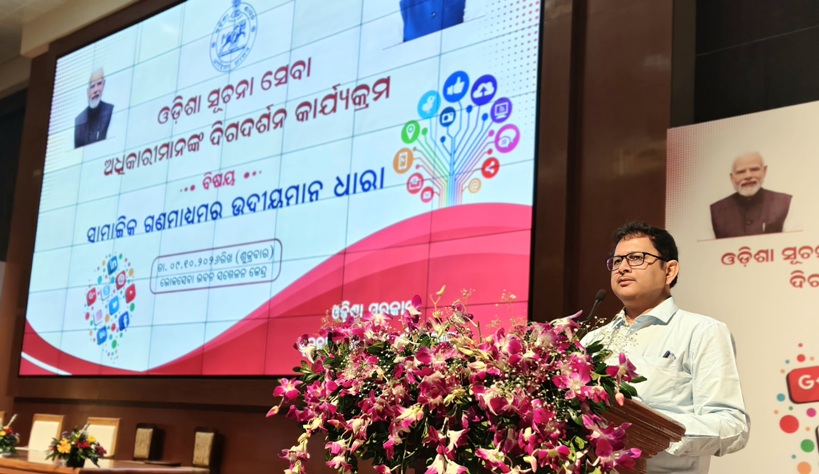
Addressing Odisha
Information Service (OIS) officers at an interactive orientation programme at
Loka Seva Bhavan here, he stressed the need for transparent, ethical and
citizen-centric communication to bridge the gap between government policies and
public understanding.
Drawing on more than
three decades of experience observing governance at the State and Centre, Mishra
said that, barring critical sovereign concerns such as national security, the
core issues of governance ultimately converged on the common citizen. With the
communication landscape undergoing a fundamental transformation, he urged
information officers to understand emerging channels of engagement and adapt
their approaches to the changing expectations of the public.
“The communication landscape has undergone a
radical transformation, and officers must decipher and navigate this evolving
process,” he said, emphasising that effective public communication was
essential to ensuring that government initiatives translated into tangible
benefits for citizens.
Invoking
philosophical and literary traditions, Mishra underlined the enduring
relationship between dialogue, social cohesion and civilisational progress.
Referring to the Krishna–Arjuna dialogue in the Bhagavad Gita and the Vashistha–Rama discourse in the Yoga Vashistha, he observed that
communication had long been central to the articulation of ethical principles
and ideals of governance, including the concept of Ramrajya.
Citing sociologist
David Riesman’s seminal work The Lonely
Crowd, he drew attention to the wider social consequences of institutional
communication. The words used by public servants, he said, could shape public
attitudes, strengthen civic bonds or deepen alienation.
“Words do not merely affect us temporarily;
they socialize or unsocialize us. Every piece of institutional communication
either builds civic cohesion or deepens alienation,” he said.
On administrative
accountability, Mishra referred to Albert Camus’s short story The Guest to illustrate the moral
dilemmas that public officials may encounter in the discharge of their duties.
He emphasised that civil servants, by virtue of their institutional
responsibilities, were accountable to both the State and its citizens.
Distinguishing public
duty from personal considerations, he said the demands of Rajakarya (official duty) must take precedence over Pitrukarya (personal or familial
obligations) in the discharge of public responsibilities. Government service,
he observed, was a conscious choice that entailed an enduring commitment to
duty, institutional integrity and public trust.
While criticism and
scepticism were part of public life, he said, effective administration required
resilience, constructive engagement and a strong sense of accountability.
Public servants, he added, must remain committed to the institutions they serve
while ensuring that their actions and communication reflect the larger public
interest.
The programme also
featured an experiential blindfold simulation designed to demonstrate the
complexities of message transmission, leadership, trust and directional
ambiguity. Reflecting on the exercise, Mishra cautioned officers against
equating the mere dissemination of information with meaningful communication.
“Merely passing down a pamphlet, booklet, or
hoarding is not communication — it is merely functioning as a postman,” he
said, stressing that genuine engagement required clarity, actionable guidance,
empathy and active listening.
He described
communication as a two-way process in which feedback and an understanding of
citizens’ concerns were as important as the delivery of official messages.
Information officers, he said, should equip their teams and communication
networks with adequate context and clear instructions to ensure that welfare
schemes and government initiatives reached the last mile without distortion or
loss of meaning.
The emphasis, he
indicated, must be on enabling citizens not merely to receive information but
also to understand government decisions, access public services and engage
meaningfully with the administration.
Sanjay Kumar Biswal,
Director of the Information and Public Relations (I&PR) Department, Government
of Odisha, attended the programme along with senior officers and
representatives of the State administration.